


Nature - 2019 January - Vol 566 No 7743
Publisher: Nature
Format: Paperback
ISBN: 9770028083095
Assuming you meant Nature – 2019 February – Vol. 565 No. 7743 (2019) — the wonderfully ominous “SPACE AND CHIME” issue rather than the earlier January edition — here’s your blurb:
There are magazines that promise escapism, and then there is Nature, which prefers to remind readers that the universe is firing mysterious radio signals across incomprehensible distances while humanity frantically builds giant metal listening devices in snowy fields to figure out why.
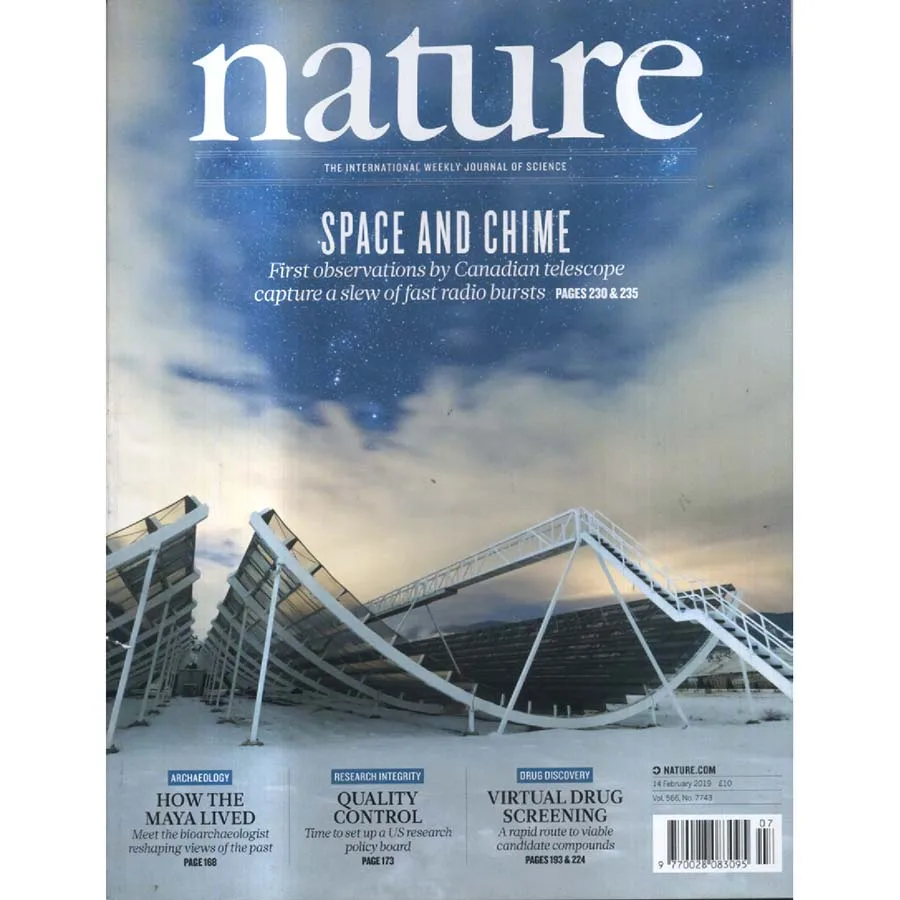
Nature – February 2019, Vol. 565 No. 7743 arrives beneath the magnificent headline “SPACE AND CHIME”, sounding less like a scientific breakthrough and more like an obscure progressive rock album recorded entirely inside a Canadian observatory. The cover features the CHIME telescope array under cold night skies, quietly listening to the cosmos in the hope that space might finally explain itself. So far, space appears committed to remaining cryptic.
The lead feature concerns fast radio bursts — brief, powerful flashes of energy arriving from deep space with all the reassuring subtlety of the universe sending missed calls at random intervals. Scientists, naturally, are thrilled. Humanity has always reacted to unexplained cosmic phenomena by building larger equipment and inventing increasingly alarming terminology.
The cover itself is wonderfully cinematic. The telescope structures stretch beneath a frozen sky like something from a Denis Villeneuve film about mathematically depressed astronomers. There is a peculiar beauty to it: mankind standing in the snow, pointing giant scientific apparatus at the heavens, hoping the void eventually returns our messages.
And because this is Nature, the issue refuses to stop at mysterious cosmic transmissions. Elsewhere inside, archaeologists are rethinking how the Maya lived, researchers debate scientific integrity and quality control, and drug discovery is being accelerated through virtual screening. One moment you are contemplating alien-adjacent radio bursts, the next you are worrying about US research policy boards and computational chemistry. It is all very intellectually exhausting in the best possible way.
The “Quality Control” feature is especially charming because it highlights the deeply human side of science. Even while searching the cosmos for unexplained phenomena, humanity still requires committees, governance structures, and meetings about standards. Somewhere beneath every grand scientific breakthrough lurks a PDF policy document and someone asking if the formatting is correct.
One of the enduring pleasures of Nature is the extraordinary calmness with which it presents astonishing information. “First observations capture a slew of fast radio bursts,” it notes politely, as though discovering mysterious extragalactic signals is no more dramatic than spotting a slightly unusual pigeon. The magazine never panics. It simply keeps cataloguing the increasingly bizarre reality we inhabit.
Owning a copy of Nature also projects a very specific kind of intellectual aspiration. It implies someone who occasionally spends evenings pondering cosmology, archaeology, and virtual drug screening rather than merely watching television. Whether you actually read the dense astrophysics article or simply admired the snowy telescope photography while feeling mildly inadequate is largely irrelevant. The magazine functions equally well as scientific literature and decorative evidence of ambition.
This early-2019 issue now feels particularly evocative of that optimistic late-2010s scientific atmosphere — a period when enormous discoveries seemed to arrive weekly, from deep-space mysteries to machine-assisted medicine, all delivered with polished graphics and extraordinary confidence.
Condition is listed as Good, meaning this copy has survived the usual hazards faced by elite scientific journals: overloaded backpacks, research-office coffee exposure, bedside “important reading” stacks, and several years of people intending to properly understand fast radio bursts “when they had more time”.
An excellent issue for science enthusiasts, astronomy lovers, conspiracy theorists attempting to look respectable, or anyone who enjoys magazines that casually combine mysterious cosmic signals, Maya archaeology, and bureaucratic research policy into one beautifully intimidating package.
Keep browsing: See more Nature Journal books Other books by Nature
